

Quick Answer
A working digital marketing strategy for small businesses in 2026 combines a conversion-ready website, local SEO, helpful content, one or two focused social channels and a measured mix of organic and paid, run as one connected system with a clear goal, a realistic budget and a monthly scorecard. Build the plan and the website first, win local search next, add paid ads to speed things upand judge results at 90 days on leads and cost per lead, not likes.
Most small business owners don't lack effort. They lack structure. You post on Instagram one week, run a few Google ads the next and somewhere in between forget to update your Google Business Profile. Six months later, there's a lot of activity but very little to show for it.
This guide gives you a practical, step-by-step digital marketing strategy for small businesses in 2026, written for owner-managed businesses in Chennai and across India: clinics, salons, retailers, service providers and B2B firms. You don't need a marketing degree or an unlimited budget to follow it.
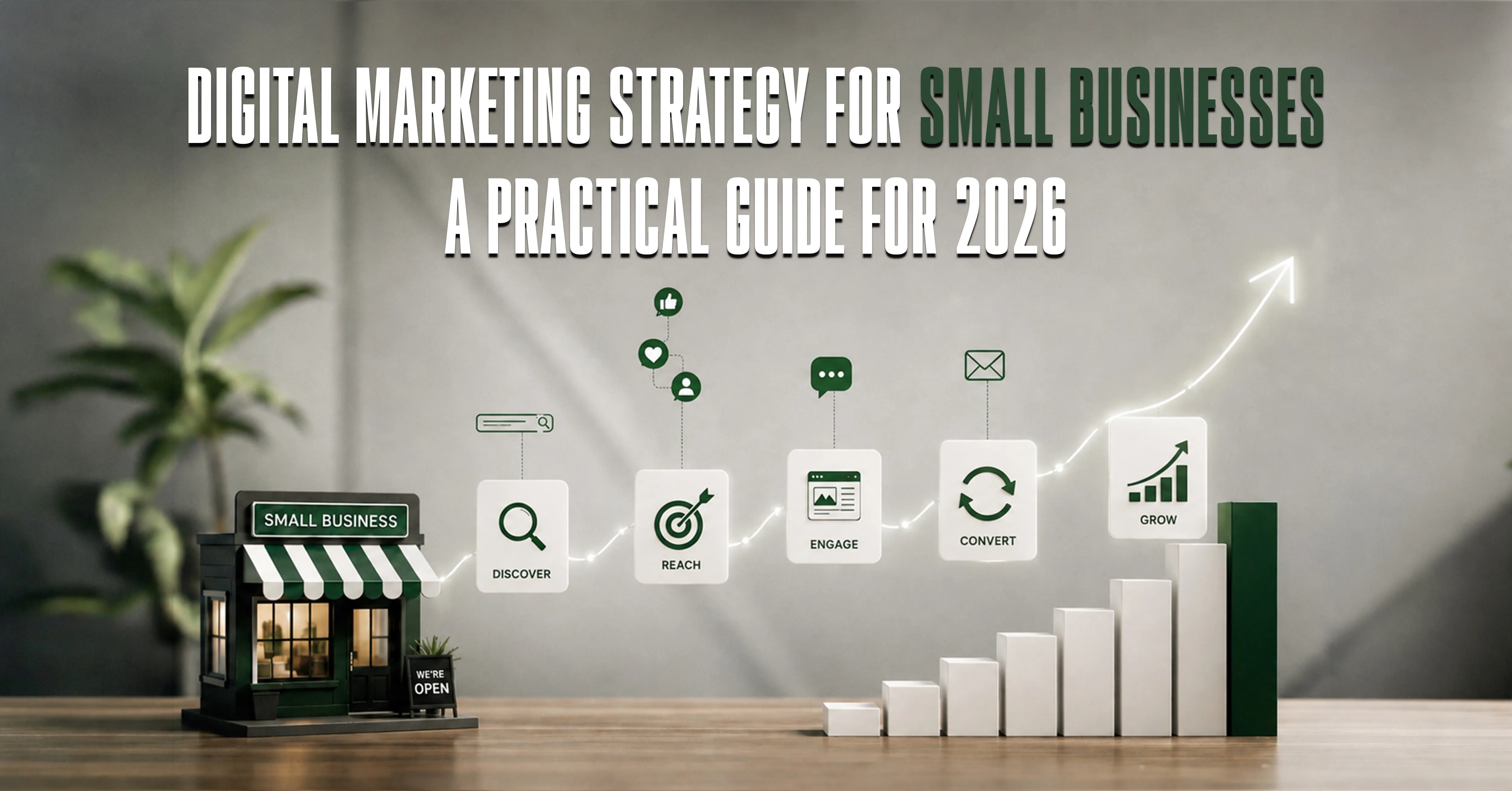
The 8-Step Strategy at a Glance
| Step | What you do | Typical set-up time | Metric that proves it works |
|---|---|---|---|
| 1. Plan | Define customer, one goal, budget and allowable cost per lead | About 1 week | One written 90-day goal |
| 2. Website | Make it fast, clear and built to convert | 1 to 6 weeks, depending on fixes vs rebuild | Enquiry conversion rate |
| 3. Local search | Fix Google Business Profile, listings and reviews | 1 to 2 weeks | Calls, direction requests, profile actions |
| 4. Content | Answer real customer questions on service pages and blog | Ongoing, 2 to 4 pieces a month | Organic leads, rankings on money pages |
| 5. Social media | Pick 1 or 2 platforms and show real work | Ongoing | Enquiries from social, not follower count |
| 6. SEO + paid ads | Use ads for speed, SEO for compounding growth | Ads: days. SEO: 3 to 6 months | Cost per lead by channel |
| 7. Budget | Split spend across channels that keep working | 1 day, review quarterly | Blended cost per lead |
| 8. Tracking | Review a monthly scorecard | 1 hour a month | Leads, cost per lead, lead-to-customer rate |
Why Digital Marketing Matters for Small Businesses
Customers rarely walk in cold anymore. Before calling a shop, hiring a service or visiting a store, most people have already searched, compared and formed an opinion online. For a small business this works in your favour if you use it well:
- Lower cost of entry. You don't need a TV budget to appear next to a larger competitor.
- Better targeting. You can reach people by location, interest and intent instead of guessing.
- Full measurability. Every click, call and enquiry can be tracked and improved.
- A level playing field. A well-optimised small business can outrank a bigger, slower-moving competitor, especially in local search.
Digital marketing isn't an optional extra anymore. It's the front door to your business.
Step 1: Start With a Plan, Not a Platform
Before touching social media or ads, answer three questions:
- Who is your ideal customer? Age, location and the specific problem they are trying to solve.
- What do you want them to do? Call, book, buy or fill a form. Pick one primary action.
- What is realistic for your budget and time? A one-person business should not try to run five platforms at once.
Then write your plan as a single sentence you can check in 90 days. For example: “In the next 90 days we will generate 40 qualified enquiries a month from Chennai customers searching for our service, at under ₹1,500 per lead, using local SEO, Google Ads and fast WhatsApp follow-up.”
Know your allowable cost per lead before you spend
The number that keeps every later decision honest is the most you can pay for a lead and still profit:
Example: an average sale of ₹20,000, a 40% gross margin and a 25% close rate gives ₹20,000 × 0.40 × 0.25 = ₹2,000. If a channel produces leads at ₹2,500 each, it loses money; at ₹900 each, it deserves more budget. Use your own numbers.
Step 2: Build a Website That Actually Converts
Your website is your digital storefront. If it's slow, cluttered or unclear about what you offer, every other marketing effort is pouring water into a leaking bucket. It matters more than many owners expect: Statcounter data showed roughly two-thirds of web traffic in India (about 66% in July 2026) coming from mobile devices, so your site has to work on a phone first.
A website that supports your strategy should be:
- Fast on mobile. Google's "good" thresholds are Largest Contentful Paint under 2.5 seconds, Interaction to Next Paint under 200 ms and Cumulative Layout Shift under 0.1.
- Clear about the next step. A visible call, WhatsApp or enquiry button on every key page.
- Structured around services. One page per core service (and per location where relevant), not just a generic "About Us".
- Trustworthy. Real photos, named team members, reviews, certifications and case studies.
- Tracked. Calls, form submissions and WhatsApp clicks recorded as events in Google Analytics 4, so you can see which channel produced each lead.
If your current site isn't generating enquiries, get it reviewed by a digital marketing agency in Chennai before you spend more on traffic you can't convert.
Step 3: Win Local Search Before You Chase National Rankings
For most small businesses, including clinics, salons, agencies, retail stores and service providers, local customers are where the real revenue is. Local SEO pays off fastest because it reaches people already searching with intent to buy. Focus on:
- Google Business Profile: accurate name, address, phone, primary and secondary categories, services, opening hours, attributes and fresh photos.
- Consistent details (name, address, phone) across your website, directories and social profiles.
- Reviews: ask every happy customer right after the job, reply to every review within a couple of daysand never buy fake ones.
- Location-specific content: service pages and blog posts that mention the areas of Chennai you actually serve.
A simple review request that works: send a WhatsApp message the same day with your direct Google review link and one line, such as “Thanks for choosing us today. If you were happy with the service, a 30-second review would really help other Chennai customers find us.” For a deeper set-up walkthrough, read our guide to local SEO for small businesses.
Step 4: Create Content That Builds Trust
Content marketing works because it answers a customer's question before they call you. Match each piece to what the searcher actually wants:
| Searcher intent | Example search | Content to publish |
|---|---|---|
| Ready to buy or book | "digital marketing agency in Chennai" | Service page with proof, pricing guidance and a clear call to action |
| Comparing options | "agency vs freelancer Chennai" | Comparison guides, checklists, "how to choose" articles |
| Solving a problem | "why is my website not getting leads" | How-to guides, explainers, short videos |
| Checking credibility | "[your brand] reviews" | Case studies, testimonials, before/after results, FAQs |
Start with the pages closest to revenue (service pages), then comparison and problem-solving content, then case studies. Two to four solid pieces a month beats daily generic posts. This kind of content improves search visibility over time and builds the trust that turns a visitor into an enquiry.
Chennai Healthcare Clinic: Building Search Authority in 90 Days
Client Type
Multi-treatment clinic in Chennai
What Was Fixed
Published 4 treatment-specific FAQ service pages + localized Google Business Profile overhaul
90-Day Result
Direct patient calls grew from 8 to 44/month; appointment enquiry cost dropped below ₹420
By answering specific patient concerns about procedure pricing, recovery time and doctor qualifications directly on high-intent pages, organic traffic converted into phone calls and scheduled visits at over 4× the previous rate.
Step 5: Use Social Media With Intention
You don't need to be everywhere. Pick one or two platforms where your customers actually spend time and commit to consistency over volume.
| Platform | Best for | What to post |
|---|---|---|
| Instagram / Facebook | Consumer and local businesses | Short videos, before/after work, behind the scenes, customer stories |
| B2B, professional services, recruiting | Opinions, case snippets, founder and team expertise | |
| YouTube | Complex or high-consideration purchases | Explainers and how-to videos that keep working for years |
| WhatsApp Business | Converting interest into enquiries in India | Catalogue, quick replies, follow-ups within minutes |
What works best in 2026: real, behind-the-scenes content over polished stock imagery, short-form video showing your product or process, prompt replies to comments and messagesand genuine testimonials. Social media is a trust-building channel that supports every other part of your strategy. If you struggle with consistency or turning followers into enquiries, a social media marketing agency in Chennai can build you a content system instead of reactive posting.
Step 6: Combine SEO and Paid Ads, Don't Choose One
SEO and paid advertising solve different problems. Paid ads buy speed. SEO builds an asset that keeps working after you stop paying.
| Channel | Best for | Typical timeline | Watch out for |
|---|---|---|---|
| SEO | Long-term, compounding organic visibility | 3 to 6+ months | Slow start; needs patience and good content |
| Local SEO | High-intent, nearby customers | 1 to 3 months | Incomplete profile, few reviews |
| Paid ads (Google / Meta) | Immediate visibility and leads | Days | Costs stop the moment spend stops; weak landing pages waste budget |
| Content marketing | Trust-building and search authority | Ongoing | Publishing without a topic plan |
Small businesses with limited budgets often do best by leaning on SEO and local SEO for sustainable growth and using paid ads selectively for promotions, launches and gaps. A practical tactic: use a small Google Ads test to learn which searches and messages actually generate enquiries, then build SEO content around the winners. Our comparison of SEO vs Google Ads shows which to prioritise for your goal and budget. If you are unsure where your site stands today, a professional SEO services audit is the fastest way to find what is holding back your rankings.
Step 7: Set a Realistic Budget
A common rule of thumb is to invest roughly 5 to 10% of revenue in marketing, with newer businesses aiming for growth often going higher. A simple starting split:
| Allocation | Share | Example on ₹50,000 a month (illustrative) |
|---|---|---|
| SEO, local SEO and content (long-term compounding) | 40% | ₹20,000 |
| Paid advertising (immediate visibility) | 30% | ₹15,000 |
| Social media (trust and engagement) | 20% | ₹10,000 |
| Tools and analytics (tracking what works) | 10% | ₹5,000 |
Adjust to your industry and competition, but keep the principle: prioritise channels that keep working after you stop paying for them.
Step 8: Track the Right Metrics
Don't stop at vanity numbers like likes and followers. Track what connects to revenue:
| Metric | How to calculate | Where to find it |
|---|---|---|
| Leads | Calls + forms + WhatsApp enquiries | GA4 events, call tracking, CRM or a simple sheet |
| Conversion rate | Leads ÷ website visitors × 100 | Google Analytics 4 |
| Cost per lead (CPL) | Channel spend ÷ leads from that channel | Ad platforms + your lead sheet |
| Lead-to-customer rate | Customers ÷ leads × 100 | Your own sales records |
| Organic visibility | Impressions and clicks for key queries | Google Search Console |
Review the scorecard monthlyand judge each channel at the 90-day mark. Double down on what produces leads below your allowable cost per lead and stop what does not.
Your First 90 Days: A Simple Roadmap
| Period | Focus | Deliverables |
|---|---|---|
| Days 1 to 30: Foundation | Plan, website fixes, tracking, Google Business Profile | Written goal, allowable CPL, GA4 events, complete profile, 10+ new reviews requested |
| Days 31 to 60: Traction | Service pages, first content, first ad test | 2 to 4 helpful pages or posts, one focused ad campaign, weekly lead log |
| Days 61 to 90: Decide | Scale winners, cut losers | Channel-wise CPL report, revised budget split, next-quarter plan |
What This Looks Like by Business Type
| Business type | Lead channel to prioritise | First move in month one |
|---|---|---|
| Clinics and healthcare | Local SEO, reviews, service pages | Complete Google Business Profile; add one page per treatment with FAQs |
| Salons, retail, restaurants | Instagram, Google Business Profile, WhatsApp | Post real work weekly; add WhatsApp booking button |
| Home and local services | Local SEO plus Google Ads on high-intent searches | Location + service pages; call-tracked ads landing page |
| B2B and professional services | LinkedIn, SEO, case studies | Publish two case studies and one comparison guide |
Common Mistakes Small Businesses Make
- Running ads without a conversion-ready landing page. Fix the page first, then buy traffic.
- Ignoring Google Business Profile and reviews. They often decide whether a local customer calls you or a competitor.
- Posting with no goal or audience. Every post should support one customer action.
- Not tracking leads by source. Without it you cannot tell which channel deserves budget.
- Slow or delayed follow-up. A lead contacted within minutes converts far better than one contacted next day.
- Treating SEO, ads and social as unrelated efforts. Run them as one system.
If any of this sounds familiar, our breakdown of why digital marketing fails for growing businesses covers the most common breakdowns and how to fix them before they cost you more leads.
Final Thoughts
A digital marketing strategy for small businesses doesn't need to be complicated. It needs to be consistent. Start with a clear plan, build a website and local SEO presence that converts, create content that answers real customer questions and track results closely enough to know what is working. Trends will change (see what is worth adopting in our digital marketing trends for 2026 guide), but this foundation will not.
If you'd rather have a team that builds these systems for a living, BRAND 360s is a full-service digital marketing agency in Chennai built to turn this exact strategy into measurable growth. If you are still choosing a partner, use our checklist for choosing a digital marketing agency in Chennai.
Sources and Further Reading
- Statcounter GlobalStats: Mobile vs desktop market share in India
- Google web.dev: Core Web Vitals thresholds
