

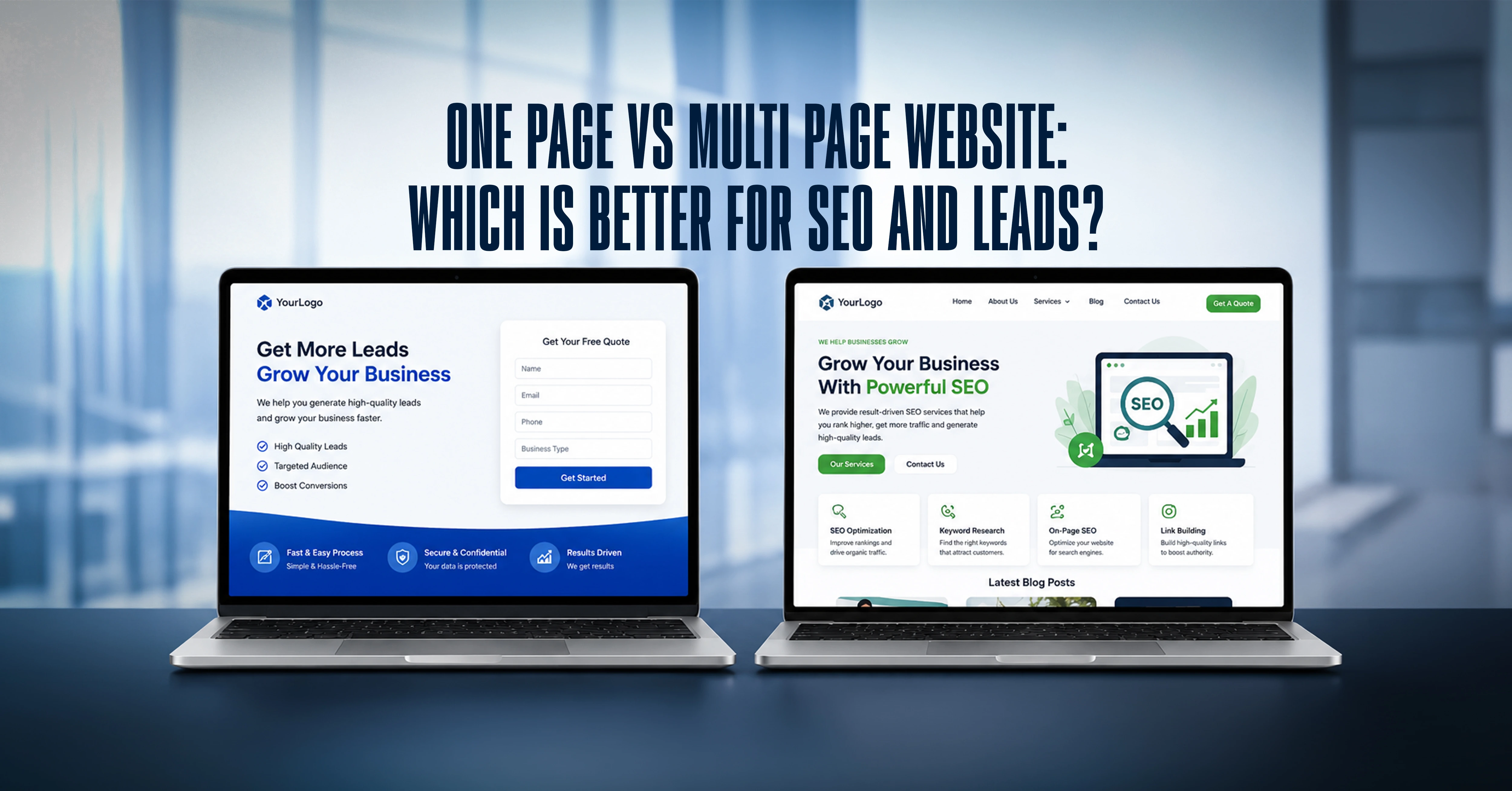
Most businesses think this is a design decision.
It is not.
It is a business decision.
When business owners discuss websites, the conversation usually revolves around aesthetics. They talk about layouts, colors, animations, modern design trends, and visual appeal. Somewhere along the way, someone asks a seemingly simple question:
"Should we build a one-page website or a multiple-page website?"
At first glance, it feels like a technical choice.
In reality, the answer influences far more than design.
It affects how customers perceive your business.
It affects how Google understands your services.
It affects how easily prospects trust you.
Most importantly, it affects how effectively your website contributes to business growth.
At BRAND 360s, we've seen businesses spend significant amounts building websites that looked impressive but quietly limited their future growth. In many cases, the issue was not design quality. The issue was choosing a website structure that did not align with the company's goals.
In many cases, the issue was not design quality — it was choosing a structure that did not align with goals, which is why strategic website design in Chennai should always begin with a business conversation, not a design one.
The truth is that neither one-page websites nor multiple-page websites are universally better.
The right choice depends entirely on what your business is trying to achieve.
Unfortunately, most businesses ask the wrong question.
Instead of asking:
"Which structure supports our growth strategy?"
they ask:
"Which structure looks modern?"
That distinction changes everything.
Why This Decision Matters More Than Most Businesses Realize
Your Website Structure Influences Customer Behaviour
Every visitor who lands on your website is trying to answer a series of questions.
Who are you?
Can you help me?
Can I trust you?
What should I do next?
The way information is organized directly affects how quickly those questions get answered.
Website Architecture Shapes Perception
Customers rarely analyse websites consciously.
Yet they immediately notice whether a website feels:
- clear
- organized
- trustworthy
- professional
Good architecture creates confidence.
Poor architecture creates hesitation.
Structure Influences Growth Potential
A website is not only serving today's needs.
It is supporting tomorrow's opportunities.
That is why website structure should be viewed through a strategic lens rather than a visual one.
Understanding the Difference Between One-Page and Multiple-Page Websites
Before deciding which is better, we need clarity. Just as businesses often debate between a custom website vs template website, the choice between one-page and multiple-page structures comes down to what the business is actually trying to achieve — not what looks popular at the time.
What Is a One-Page Website?
A one-page website places all major content on a single URL.
Visitors scroll through sections such as:
- About
- Services
- Testimonials
- Portfolio
- FAQs
- Contact
Navigation links simply jump to different sections on the same page.
Everything exists in one continuous experience.
What Is a Multiple-Page Website?
A multiple-page website separates information into dedicated pages.
Examples include:
- Home
- About
- Services
- Individual Service Pages
- Portfolio
- Case Studies
- Blog
- Contact
Each page has a specific role.
Neither Is Automatically Better
This is where many articles get it wrong.
A one-page website is not inherently outdated.
A multiple-page website is not automatically superior.
The answer depends on context.
The Real Question Businesses Should Be Asking
What Is the Website Expected to Do?
The most important question is surprisingly simple.
What is the website expected to achieve?
Different goals require different structures.
Some Websites Are Built for Information
A speaker, consultant, or portfolio website may only need to communicate a few key points.
The goal is simplicity.
Some Websites Are Built for Growth
Businesses investing in:
- SEO
- content marketing
- lead generation
- authority building
typically require far more depth.
Growth requires room to expand.
When a One-Page Website Is the Right Strategic Choice
One-page websites often receive unfair criticism.
In the right circumstances, they perform extremely well.
Startups Testing New Ideas
Imagine a startup validating a new product.
The goal is speed.
Not complexity.
Launching quickly matters more than building a large content ecosystem.
Businesses Offering One Core Service
A consultant who offers one specialized service may benefit from a focused one-page website.
The customer journey is simple.
The offering is clear.
The decision-making process is relatively short.
Campaign-Based Marketing
Landing pages are essentially one-page websites.
They often convert exceptionally well because they remove distractions and keep visitors focused on a single objective.
Why One-Page Websites Sometimes Convert Better
This is where the discussion becomes interesting.
Simplicity Reduces Friction
Every additional page introduces another decision.
Every decision creates friction.
A well-designed one-page website removes many of those decisions.
Narrative Flow Becomes Easier
One-page websites allow businesses to guide visitors through a structured story.
Problem.
Solution.
Proof.
Action.
When done correctly, this flow can be very persuasive.
Visitors Stay Focused
Without complex navigation, users remain concentrated on the core message.
That focus can improve conversions for simple offers.
The Hidden Limitations of One-Page Websites
This is where many businesses encounter problems.
Simplicity Eventually Becomes Restrictive
What works at launch may become a limitation later.
As businesses grow, they naturally introduce:
- additional services
- case studies
- content
- resources
Eventually everything becomes crowded.
SEO Opportunities Become Limited
Google ranks pages.
Not sections.
This creates a major limitation.
A one-page website provides fewer opportunities to target different search intents.
Trust Building Has Less Space
Complex services often require detailed explanations.
The more expensive the purchase, the more reassurance customers need.
One page can only hold so much information before becoming overwhelming.
Why Multiple-Page Websites Often Win Long-Term
This is where growth-oriented businesses should pay attention.
A scalable website development company in Chennai ensures your site architecture is built to expand without requiring a complete rebuild every time your business grows.
Growth Creates Complexity
Most successful businesses expand.
They add services.
They enter new markets.
They create new offers.
A multiple-page website accommodates growth naturally.
Dedicated Pages Build Authority
Imagine an architecture firm.
One service page may focus on residential projects.
Another on commercial projects.
Another on interior planning.
Each page strengthens relevance.
Google Understands Expertise Better
Multiple pages allow businesses to demonstrate depth.
Google increasingly rewards topical authority.
Dedicated pages help establish that authority.
How SEO Changes the Equation
When businesses compare one-page and multiple-page websites, SEO is often where the difference becomes most visible. Working with a focused SEO services in Chennai partner helps businesses understand which website structure will actually support their ranking goals before they build — not after.
One Page Means One Primary Ranking Opportunity
A one-page website can rank.
That is an important point.
Many people incorrectly assume one-page websites cannot appear in Google.
They can.
The challenge is that a single page can only carry so much topical relevance.
Imagine a business offering:
- Website Design
- Branding
- SEO
- Performance Marketing
- Graphic Design
Trying to rank one page for all five services becomes increasingly difficult.
Multiple Pages Create More Entry Points
A multiple-page website gives Google more opportunities to understand your business.
Instead of one page attempting to explain everything, dedicated pages can focus on specific topics.
For example:
- Website Design Company Chennai
- Branding Agency Chennai
- SEO Services Chennai
- Performance Marketing Agency Chennai
Each page serves a different search intent.
Topical Authority Requires Depth
Google increasingly rewards expertise.
Businesses that publish service pages, guides, blogs, case studies and resources create a stronger authority signal than businesses relying on a single page.
Customer Psychology Changes Everything
SEO matters. People matter more. In fact, most of the time why business websites fail to convert has very little to do with traffic and everything to do with how well the website addresses the psychology of the person reading it.
Customers Do Not Buy Websites
This is one of the biggest misconceptions in the industry.
Customers do not buy websites.
They buy outcomes.
They want:
- more enquiries
- more trust
- more visibility
- more growth
The website is simply the vehicle.
Different Buyers Need Different Information
Imagine a business owner evaluating an agency.
The founder may care about strategy.
The marketing manager may care about execution.
The operations manager may care about the process.
A single page often struggles to satisfy all of those needs.
Trust Is Built Through Detail
The larger the investment, the more information people seek.
A customer spending ₹5,000 behaves differently from a customer spending ₹5 lakhs.
Trust requires depth.
Depth requires structure.
Founder Insight From BRAND 360s
One of the Biggest Misconceptions We See
One of the biggest misconceptions we see at BRAND 360s is that businesses assume shorter websites convert better because people have shorter attention spans.
The reality is very different.
People do not avoid information.
People avoid irrelevant information.
When a prospect is evaluating a serious purchase, they actively look for detail.
They want reassurance.
They want confidence.
They want evidence.
We have seen businesses replace detailed websites with minimalist one-page designs because they looked modern.
Six months later they wonder why enquiry quality declined.
The issue was never designed.
The issue was missing trust-building content.
Modern customers do not need less information.
They need better information.
Why Many Businesses Choose the Wrong Website Structure
They Follow Trends Instead of Strategy
A design trend becomes popular.
Competitors start copying it.
Soon everyone assumes it is the correct solution.
Unfortunately trends rarely consider business objectives.
They Build for Today Instead of Tomorrow
A startup with one service today may have five services next year.
A business targeting one city today may target multiple regions tomorrow.
Growth creates new requirements.
They Underestimate Future SEO Needs
Many businesses launch with a one-page website and later realize they need:
- service pages
- city pages
- landing pages
- blogs
- resources
At that point rebuilding becomes inevitable.
Real Business Examples
Chennai Consultant
A consultant offering one specialized service may perform extremely well with a focused one-page website.
The value proposition is clear.
The decision-making process is short.
Chennai Dental Clinic
A clinic offering:
- implants
- orthodontics
- cosmetic dentistry
- general dentistry
needs dedicated pages.
Patients search differently for each service.
Chennai Manufacturer
A manufacturer may require:
- product pages
- industry pages
- certifications
- case studies
Trying to fit everything into one page would limit visibility and trust.
Growing Startup
Many startups begin with a one-page website.
The smartest ones evolve before growth demands it.
The Hybrid Approach Most Businesses Overlook
The debate is often presented as either-or.
Reality is more nuanced.
Simplicity and Depth Can Coexist
Many successful websites combine:
- a simple homepage
- focused service pages
- case studies
- educational content
The result is clarity without sacrificing depth.
Landing Pages Still Matter
Even businesses with large websites benefit from focused landing pages.
Especially for:
- Google Ads
- Meta Ads
- specific campaigns
Strategy Should Drive Structure
The best architecture is the one that aligns with customer behaviour.
Not design trends.
Which Website Structure Converts Better
There is no universal winner.
Simple Offers Often Favour One Page
When the offer is straightforward, simplicity can improve conversion.
Complex Offers Usually Need Multiple Pages
Higher-ticket services require more trust.
More trust requires more information.
Customer Behaviour Determines the Answer
The right structure depends on:
- what customers need
- how they buy
- how much risk they perceive
Conversion is ultimately a psychological problem.
How to Decide Between a One-Page and Multiple-Page Website
If you're unsure, ask yourself a few questions.
Do You Offer One Service or Multiple Services
The more services you offer, the more likely you need multiple pages.
Is SEO Important to Your Growth Strategy
Businesses investing in SEO generally benefit from a scalable multi-page structure.
Do Customers Need Detailed Information Before Contacting You
If the answer is yes, depth matters.
Depth is easier to provide through multiple pages.
Where Will the Business Be Three Years From Now
This may be the most important question of all.
Build for where you are going.
Not only for where you are today.
Conclusion
The debate between a one-page website and a multiple-page website is not really about design.
It is about business strategy.
A one-page website can be extremely effective when speed, simplicity and focus are the priority.
A multiple-page website becomes increasingly valuable when growth, SEO, authority and scalability matter.
The businesses that achieve the strongest digital results rarely choose based on trends.
They choose based on customer behaviour, business objectives and future growth plans.
A weak website rarely announces its failure.
It simply allows potential customers to disappear quietly every day.
Industry insights on how website structure impacts search engine rankings consistently show that architecture decisions made at the build stage directly influence organic performance — which is why structure should always be a strategic choice, not an afterthought.
The right website structure helps ensure that does not happen.
Ready to Build a Website That Supports Growth
The best websites are not the ones that win compliments. They are the ones that win customers. Every business invests time, effort and money bringing attention to its website. Whether that attention comes from Google, referrals, social media or advertising, the opportunity already exists.
The real question is what happens after visitors arrive. Do they understand your value? Do they trust your business? Do they feel confident enough to take the next step? That is exactly why knowing how to choose the right website design company in Chennai matters as much as choosing the right website structure — because strategy, structure and execution all need to work together.
At BRAND 360s, we believe websites should do more than look professional. They should communicate trust, clarify value, support marketing and contribute to business growth.
Because the goal is not simply to create a better website.
The goal is to create a better business.
Ready to build a website that supports your growth?
