

Quick Answer
For a simple, single-page website on a tight budget, a freelancer is usually the more cost-effective choice. For a business website that must generate enquiries, rank on Google and scale as you grow, a web design agency in Chennai typically delivers better long-term value, even at a higher upfront cost, because design, development and SEO work together instead of depending on one person's bandwidth. If your project sits in between, a hybrid (a freelancer for build plus specialist SEO support) can work when scope and ownership are agreed in writing.
If you've started researching this decision, you've probably noticed the price gap. A freelancer might quote a fraction of what an agency charges for what looks like the same website. So why do so many established businesses still choose agenciesand when is that gap actually worth paying?
This guide breaks down what you are really comparing, where each option genuinely wins, what the price difference buysand how to make the right call for your specific business, not just the cheaper one.
What You're Actually Comparing
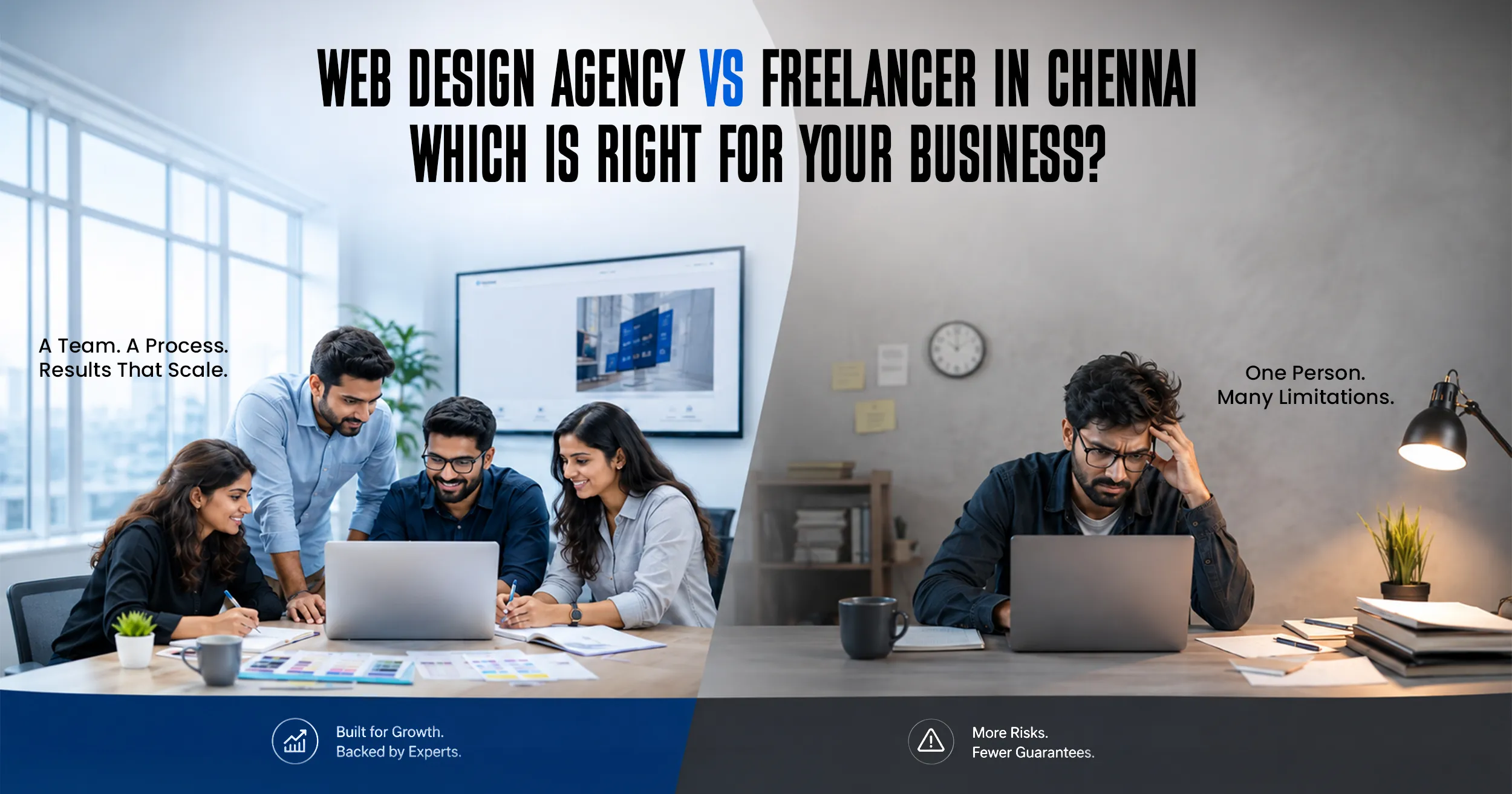
- A freelancer is one person handling your project, usually a designer or developer, sometimes both, working independently.
- A web design agency is a team: designers, developers, an SEO specialist and often a project manager, working on your website under one process. To see how that process works, our website design company in Chennai page explains our full approach.
The price difference exists because you are not only paying for design time. You are paying for how many disciplines cover your project, how much quality control sits behind it and how long someone remains accountable after launch.
The Case for Hiring a Freelancer
- Lower upfront cost. No agency overhead means freelancers can often price meaningfully below agency rates for the same brief.
- Direct communication. You talk to the person building your site, with no account manager in between.
- Fast turnaround on small projects. A single landing page or a simple 3 to 5 page site can be delivered quickly by an experienced freelancer.
- Good fit for early-stage needs. Startups testing an idea or businesses needing a basic online presence rarely need a full team.
Where Freelancers Fall Short
- One person, every skill. Design, coding, SEO and copywriting rarely all sit at expert level in one person, so something is usually deprioritised.
- No backup. If they are unavailable, ill or busy with another client, your project waits.
- Limited post-launch support. Updates and fixes depend on their availability and interest.
- Sites that look good but do not convert. Without a structured process for strategy, SEO and UX, visuals can win over business results.
None of this makes freelancers "bad". The risk profile simply changes as the website becomes more important to your revenue.
Why Businesses Choose a Web Design Agency
- A full team, not one person. Design, development and SEO work together and are reviewed by more than one set of eyes.
- Strategy before design. A good agency asks who your customer is and what action you want before designing a single screen.
- SEO-ready from the start. Clean structure, proper headings and mobile-first builds support rankings instead of working against them.
- Continuity and accountability. If one team member is unavailable, another can pick up the work.
- Built to scale. New pages, campaign landing pages and future redesigns fit an existing structure instead of starting over.
Side-by-Side Comparison
| Factor | Freelancer | Web Design Agency |
|---|---|---|
| Upfront cost | Lower | Higher |
| Skill breadth | Limited to the individual | Design, development and SEO combined |
| Process and QA | Variable | Structured, reviewed by a team |
| Business continuity | Single point of failure | Team-based, resilient |
| SEO readiness | Often basic or optional | Built in from the planning stage |
| Post-launch support | Depends on availability | Dedicated, ongoing |
| Scaling and redesigns | Depends on one person's time | Team capacity and a documented build |
| Best suited for | Small, defined, single-page projects | Business websites meant to generate leads and scale |
What the Price Difference Actually Buys
When two quotes differ, compare what each includes, not just the total. Items that are often missing from the cheaper quote are the ones you end up paying for later:
| Line item | Often in a freelancer quote | Usually in an agency quote |
|---|---|---|
| Discovery and strategy | Sometimes, informally | Yes, a defined step |
| UX and wireframes | Varies | Yes |
| Development | Yes | Yes |
| SEO set-up (structure, metadata, redirects) | Often extra or skipped | Yes |
| Copywriting | Usually extra | Often included or offered |
| Testing on real devices and browsers | Varies | Standard QA step |
| Speed optimisation and Core Web Vitals | Often extra | Usually part of the build |
| Analytics and conversion tracking | Rarely by default | Yes |
| Post-launch support and backups | Ad hoc | Defined support plan |
Add up what you would need to buy separately, plus the coordination time you will spend managing several peopleand the cost gap often narrows considerably.
Three Typical Scenarios
- A local clinic needs a 5-page brochure site. A skilled freelancer is often enough, provided they set up basic SEO and hand over all logins.
- A manufacturer wants a lead-generating site with product pages and SEO. This is agency territory: multiple disciplines, ongoing updates and search visibility matter from day one.
- A startup needs a landing page to test demand. A freelancer is usually the sensible starting point, with a plan to rebuild once the idea proves itself.
How to Decide: A Simple Scorecard
Score each question 0, 1 or 2 (0 = leans freelancer, 2 = leans agency), then add up your total.
| Question | 0 | 1 | 2 |
|---|---|---|---|
| Is the website a long-term digital asset for lead generation? | No, one-off | Somewhat | Yes, core to revenue |
| Do you need SEO built in from day one? | No | Basic | Yes, essential |
| How many pages and features are needed? | 1 to 5 pages | 6 to 15 pages | 15+ or custom features |
| Will it need regular updates and new pages? | Rarely | Occasionally | Frequently |
| How much risk can you absorb if the builder disappears mid-project? | A lot | Some | Very little |
| Do you need design, copy, SEO and development together? | Only design | Two of these | All of them |
0 to 4: a freelancer is likely enough. 5 to 8: either can work, so consider a hybrid or a smaller agency package. 9 to 12: an agency is the safer choice. If your project also needs custom functionality or integrations, review our website development services in Chennaiand if ranking on Google matters, involve SEO services from the planning stage rather than after launch.
What About a Hybrid Approach?
Some businesses hire a freelancer for the build and a specialist for SEO or content. This can work if one person owns the overall plan and you have agreed who is responsible for speed, tracking, security and updates. Without that clarity, hybrids become the most expensive option, because gaps appear between people and nobody is accountable for them.
Why This Decision Matters More in Chennai's Market
Chennai's business landscape has become genuinely competitive online. Buyers research on their phones, compare several businesses within minutes and judge your credibility before they call. Two things matter especially for a Chennai business website:
- Mobile-first performance. Roughly two-thirds of web traffic in India comes from mobile devices (about 66% in July 2026, per Statcounter), so how your site behaves on a phone directly affects enquiries. Our guide to responsive web design in Chennai covers what mobile-first really requires beyond "fitting the screen".
- Design that meets current expectations. What looked modern two years ago can feel dated fast. If a redesign is part of your decision, this breakdown of UX trends worth adopting is a useful starting point.
Local practicalities also count: being able to meet in person, working in your time zoneand receiving proper GST invoices. If you claim input tax credit, confirm whether the freelancer or agency is GST-registered before you sign.
Contract Checklist Before You Sign With Either
- You own the design files, source code, content and domain, in writing.
- You receive all logins (hosting, domain, CMS, analytics) at launch.
- Scope, number of pages, revision rounds and timeline are itemised.
- Payment is tied to milestones, not paid fully upfront.
- Post-launch support, bug-fix window and backup responsibility are defined.
- SEO basics (titles, headings, redirects, sitemap) and speed targets are included.
Questions to Ask Before You Hire Either
- Can you show me 2 to 3 examples of work similar to what I need?
- What happens if you are unavailable partway through the project?
- Is SEO structure included, or will I need to fix it separately later?
- What does support look like after the site goes live?
- Is there a written agreement covering scope, timeline and revisions?
Vague or evasive answers to any of these are a warning sign, whether you are talking to a freelancer or an agency. Red flags on either side include no portfolio you can verify, refusal to share logins, pressure to pay everything upfront and promises of "guaranteed rankings". For a wider vendor-selection framework, see how to choose a website design company in Chennai.
Final Thoughts
There is no universally better option between a freelancer and a web design agency in Chennai. The right choice depends on what your website must do for your business, not just what it costs to build.
If your project is small, well defined and low-risk, a good freelancer can deliver real value. If your website is meant to generate enquiries, support your brand and grow over the next few years, working with an established web design agency in Chennai gives you the structure, accountability and long-term support a solo freelancer isn't built to provide.
BRAND 360s designs business-focused websites for companies across Chennai that need more than a good-looking page: they need a site built to convert and scale. Talk to our team about your project requirements.
Sources and Further Reading
- Statcounter GlobalStats: Mobile vs desktop market share in India
- Google Search Central: Mobile-first indexing best practices
